


Booking direct can be just as safe as booking through a major platform when you take two precautions: pay with a credit card and verify the owner before sending any money. Direct bookings are legitimate and common across the vacation rental industry, and our tips on how to book a weekend stay and get the best deal can help you save money. The risk comes from skipping verification or paying through a method that cannot be traced or reversed, like wire transfer, gift cards, or cryptocurrency.
TL;DR:
- Pay with a credit card; disputes offer recourse, while wire transfers, gift cards, and cryptocurrency are difficult or impossible to reverse.
- Search the exact address, reverse search listing photos, and call resort staff or property managers; mismatched names, details, or duplicate listings can expose copied advertisements.
- Get a written agreement before paying, specifying the property address, dates, total cost, deposit, cancellation deadlines, refund terms, and owner’s verified legal name.
- Travel insurance can cover illness, emergencies, trip interruptions, and named storms, which card disputes do not address; consider it for costly or hurricane season trips.
Table of Contents
- How direct-booking scams and listing hijacks work
- Payment methods and traveler protections
- How to verify a property owner or hotel before you pay
- Cancellation, refunds, and policy differences when booking direct
- If something goes wrong: disputes, chargebacks and reporting fraud
- Practical checklist: 10 steps to book direct safely
- Importance of travel insurance when booking direct
- Recommended contract terms and agreements when booking direct
- Tips for ensuring secure communication with property owners
- How to verify the authenticity of the vacation rental listing
- What years of direct bookings have taught us
- How Emerald Coast By Owner helps you book direct safely
- FAQ
- Sources
How direct-booking scams and listing hijacks work
Most direct-booking fraud follows a simple pattern: a scammer copies photos and descriptions from a real listing, posts them somewhere else, and waits for a traveler to reach out. In other cases, a legitimate owner’s email account gets hijacked, and the scammer uses it to reroute an in-progress conversation toward a fake payment request. The FTC’s consumer alert on travel scams warns that scammers also buy paid search ads to push fraudulent sites above legitimate ones, so a top search result is not automatically a safe one.
The warning signs tend to repeat across cases. Watch for these before you engage further with any listing:
- A price noticeably lower than comparable properties in the same building or neighborhood.
- Pressure to wire money, pay by gift card, or send cryptocurrency “to hold the dates.”
- Contact information that doesn’t match the property’s listed owner or management company.
- A refusal to get on a phone call or video chat before you pay.
- Reluctance to provide a written agreement or confirmation number.
The FTC’s guidance is direct on payment methods: a request to pay by wire transfer, gift card, or cryptocurrency is a guaranteed red flag, since those payments are nearly impossible to trace or recover once sent. If you see any of these signs, stop the conversation and verify independently before moving forward.
Payment methods and traveler protections
Your payment method matters more than almost any other decision in a direct booking. Paying by credit card gives you dispute rights under Regulation Z and CFPB guidance, which means card issuers must acknowledge a billing error notice and investigate it, and you generally aren’t required to pay the disputed amount while that investigation is underway.
Card issuers must acknowledge a billing dispute within a legally specified timeframe and typically resolve it within a set period, giving you a real, time-bound path to recover funds if a rental turns out to be fraudulent or misrepresented, according to CFPB guidance on disputing credit card charges.
Compare that to your other options:
- Credit card: Strongest protection, formal dispute process, funds often held during investigation.
- Debit card: Weaker protection than credit, and funds leave your account immediately.
- Wire transfer, gift card, or cryptocurrency: Essentially irreversible once sent, with no built-in dispute mechanism.
- Tokenized or gateway-processed payments: Add a layer of safety by keeping your card number out of an owner’s hands and routing the transaction through a payment processor rather than a private account.
When a marketplace offers tokenized payment processing instead of a bank transfer request, that’s a meaningful safety upgrade, because the payment runs through a system built for dispute handling rather than a personal account.
How to verify a property owner or hotel before you pay
A few minutes of checking before you send a deposit can save you from a listing that doesn’t exist. Work through these steps in order:
- Search the exact address along with the words “vacation rental” to see if the same property appears on multiple sites with different contact names or prices, a common sign of a copied listing per FTC rental scam guidance.
- Call the property directly if it’s part of a resort or managed building; front desk staff can confirm whether the unit and owner name are real.
- Look up business registration for property management companies through your state’s Secretary of State website.
- Confirm the owner’s identity on a marketplace profile rather than relying solely on an email signature, since profiles are harder to fake than a one-off email.
- Request a written rental agreement with the property address, dates, total cost, and cancellation terms spelled out before paying anything.
Our guidance on contacting Gulf Coast rental owners safely walks through how to keep communication verifiable from the first message onward.
Pro Tip: Ask the owner to send you a photo of their government ID alongside a handwritten note with today’s date and the property address; scammers rarely bother with this step.
Cancellation, refunds, and policy differences when booking direct
Cancellation policies on direct bookings aren’t standardized the way they often are on large platforms, so you need to confirm the terms yourself rather than assume. A generous-sounding deposit policy from one owner can look nothing like the next owner’s terms for a similar property.
Before you pay anything, get these details in writing:
- The exact cancellation window and what portion of your payment is refundable at each stage.
- Whether the deposit is refundable, partially refundable, or non-refundable, and under what conditions.
- Who processes refunds (the owner directly or a property manager) and how long it typically takes.
- Whether you’ll receive a confirmation number or formal booking receipt once payment clears.
If a host won’t put the cancellation policy in writing or hesitates to send a confirmation number, treat that as a reason to look elsewhere. A legitimate owner has no reason to avoid documenting the terms you’ve already agreed to.
If something goes wrong: disputes, chargebacks and reporting fraud
If a direct booking falls apart, whether the property doesn’t exist or the owner stops responding, there’s a clear sequence to follow.
- Contact the owner or manager directly first and keep a written record of every message, since documentation strengthens any dispute or complaint you file later, per Usa.
- File a credit card dispute with your issuer if direct resolution fails; most issuers require you to show you attempted to resolve the issue with the merchant first.
- Report the fraud to ReportFraud.ftc.gov and your state Attorney General’s consumer protection office, which can also help if the dispute involves a business operating illegally.
- Keep copies of everything: listing screenshots, payment confirmations, messages, and the written agreement, since these materially improve your odds with both your card issuer and any regulatory complaint.
A dispute built on documentation, not just a claim that something went wrong, moves faster and succeeds more often.
Practical checklist: 10 steps to book direct safely
Run through this list before you commit to any direct booking:
- Search the property address to confirm it isn’t duplicated elsewhere.
- Call the resort or property manager if one exists.
- Confirm the owner’s identity through a marketplace profile or ID photo.
- Request a written rental agreement with full terms.
- Pay by credit card whenever the option exists.
- Refuse any request for wire transfer, gift cards, or cryptocurrency.
- Get the cancellation and refund policy in writing before paying.
- Save a confirmation number or receipt immediately after payment.
- Keep all messages and documents in one folder for the length of your trip.
- Consider travel insurance for high-value or long-lead bookings.
| Step | Why it matters |
|---|---|
| Verify the address | Exposes duplicated or copied listings |
| Pay by credit card | Preserves dispute rights under Regulation Z |
| Get terms in writing | Prevents disputes over refunds later |
| Save confirmations | Required evidence if you need to dispute a charge |
Importance of travel insurance when booking direct
Travel insurance fills a gap that payment protection alone doesn’t cover. A credit card dispute can help you recover money lost to a fraudulent listing, but it won’t reimburse a canceled trip because of illness, a family emergency, or a property that turns out to be unlivable after you’ve already arrived.
For direct bookings in particular, where cancellation policies vary property to property instead of following one platform-wide standard, insurance adds a layer of consistency you can rely on regardless of what a specific owner’s terms say. This matters most for higher-cost bookings, trips planned months in advance, or travel during hurricane season along the Gulf Coast, where weather-related cancellations are a real possibility.
When you’re comparing policies, look for ones that cover trip cancellation, interruption, and, if relevant to your destination, named-storm provisions. Pair that coverage with the payment and verification steps above rather than treating it as a substitute for them. Insurance protects your trip investment; verification and a protected payment method protect you from fraud in the first place. Used together, they cover different kinds of risk that a single precaution can’t handle alone.

Recommended contract terms and agreements when booking direct
A written agreement is the single document that protects both sides of a direct booking, and it should cover more than just dates and price. At minimum, confirm these terms before you send payment:
- The full property address and unit number if applicable.
- Check-in and check-out dates and times.
- Total cost, deposit amount, and the schedule for any remaining balance.
- Cancellation window and refund terms, spelled out by date rather than left vague.
- Occupancy limits, pet policy, and any additional fees (cleaning, damage deposit).
- The owner’s legal name and contact information, matching what you verified independently.
Ask for this agreement before you pay, not after. A property owner who hesitates to put these terms in writing, or who sends a vague confirmation with no specifics, is giving you a reason to pause. Our overview of owner-managed rental verification covers what a complete agreement should include and what questions to ask if something’s missing.
Tips for ensuring secure communication with property owners
Keep your communication with any owner inside a channel you can document and search later. Email and a marketplace’s built-in messaging system both work well for this; a string of disappearing text messages on an unfamiliar number does not.
A few habits make a real difference here. Avoid sharing sensitive personal information, like your full date of birth or driver’s license number, over an unsecured channel until you’ve confirmed the owner’s identity through at least one independent method. If an owner suddenly asks you to move the conversation to a new email address or phone number mid-booking, treat that as a reason to re-verify rather than a routine update, since hijacked accounts are one of the more common tactics behind direct-booking fraud. Our guide to contacting rental owners safely breaks down which details are safe to share early and which should wait until after you’ve confirmed who you’re dealing with.
Keeping a single written thread also makes it far easier to assemble documentation if you ever need to file a dispute or complaint later.
How to verify the authenticity of the vacation rental listing
Photos and reviews tell you a lot about a listing if you know what to check. Run a reverse image search on a few of the listing’s main photos; if the same images appear on a different site under a different owner’s name, that’s a clear signal the listing was copied.
Reviews deserve the same scrutiny. A property with no reviews at all isn’t necessarily fraudulent, especially if it’s new to a marketplace, but a listing with reviews that all read similarly or were posted within days of each other is worth a second look. When possible, reach out to a previous guest directly, through a marketplace’s messaging system or a review platform, and ask a specific question about their stay that only someone who actually visited the property could answer.
Cross-referencing the listing details themselves matters too: does the square footage, bedroom count, and amenity list match across every site where the property appears? Inconsistencies in these basic facts are a stronger warning sign than price alone, since scammers copying a listing often make small transcription errors when they repost it elsewhere.
What years of direct bookings have taught us
Having watched thousands of direct bookings move from inquiry to confirmed stay, the pattern that stands out most isn’t the scams themselves, it’s how predictable they are. The travelers who get into trouble are almost always the ones who skipped a verification step they knew they should take, usually because an offer felt time-sensitive. The ones who come out fine took an extra five minutes: a phone call, a reverse image search, a written agreement before paying.
The conventional wisdom treats direct booking as inherently riskier than booking through a large platform. In practice, the risk isn’t the booking method, it’s the absence of the same basic checks that any careful buyer would run in a private transaction.
— Joe
How Emerald Coast By Owner helps you book direct safely
We built our platform around the idea that booking direct from a property owner should feel secure, without traveler fees. Our marketplace focuses on vacation rentals in the Gulf Coast region, connecting you with owners in key destinations.
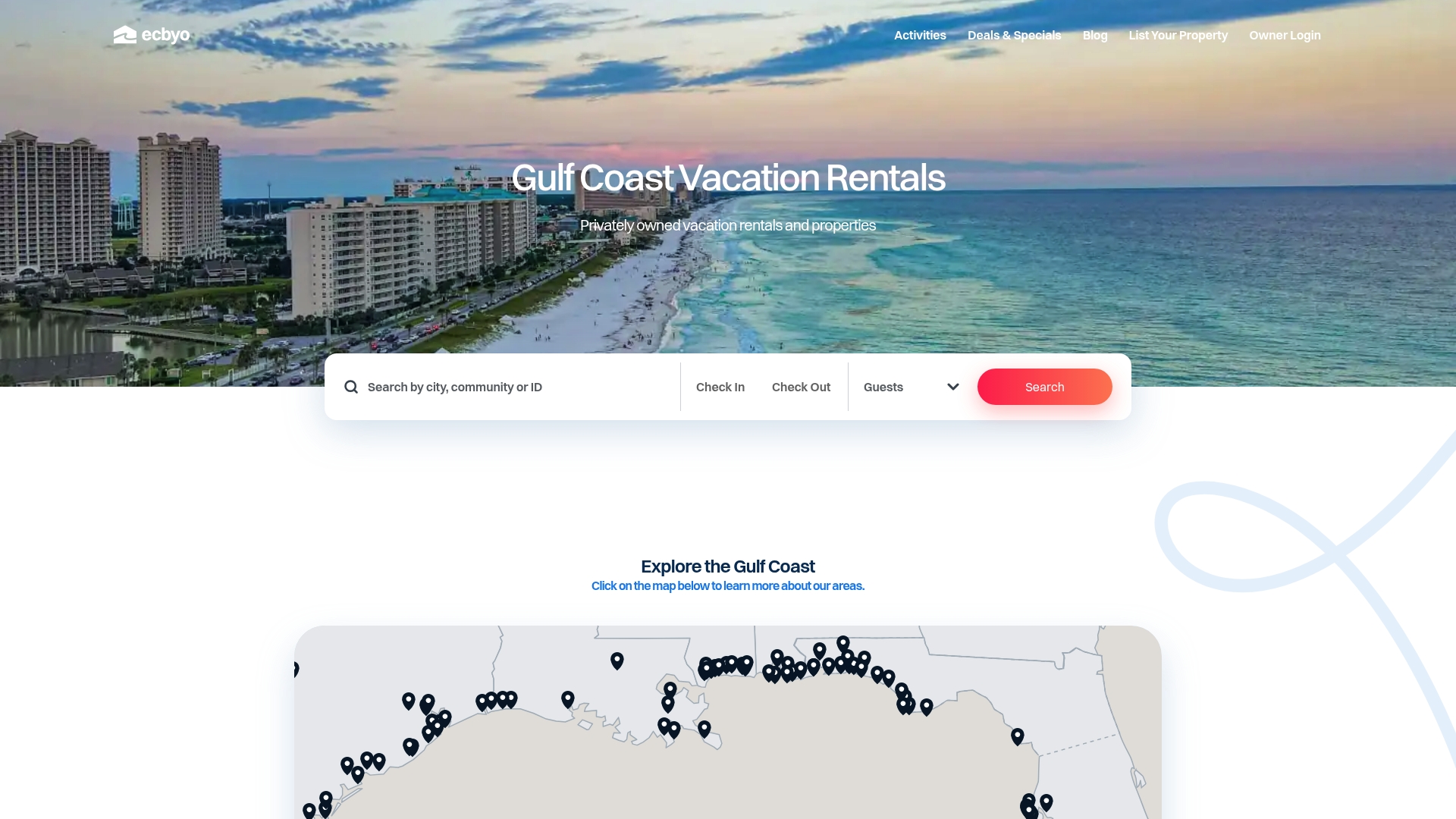
Several features on our platform are designed to enhance booking safety, including owner profiles for confirmation, internal messaging to document communication, and payment processing methods that secure your card details.
If you’re ready to see what’s available, start with our Gulf Coast vacation rentals search, or browse listings by state, including Florida, Alabama, Mississippi, Louisiana, and Texas. Property owners who want to list can do so through our ECBYO subscription for $499 per year.
FAQ
Is booking directly legit?
Yes, booking directly with a property owner or hotel is a legitimate and common way to reserve lodging. The risk isn’t the practice itself, it’s skipping verification steps or paying through an untraceable method like wire transfer or cryptocurrency.
Is Book Direct a legit website?
“Book direct” generally describes the practice of reserving through an owner’s own channel or a dedicated marketplace rather than a specific website, and legitimacy depends on the individual site or owner you’re dealing with. Always verify the owner’s identity and the property’s address independently before paying, regardless of which site or platform you’re using.
Is it better to use Booking.com or direct?
It depends on what you value most: third-party platforms often bundle in built-in cancellation handling, while booking direct can mean lower total cost and direct contact with the owner. Either option can be safe when you use a protected payment method and confirm the terms in writing before paying.
Why is Booking.com so much cheaper than direct?
Pricing varies by platform and by individual owner, and neither direct nor third-party booking is reliably cheaper in every case. Direct bookings often cost less specifically because the owner isn’t paying a platform commission or passing a service fee on to you, though this varies property by property.
Sources
- How to avoid a travel scam this summer | Consumer Advice (FTC)
- How do I dispute a charge on my credit card bill? | CFPB
- Usa
Recommended
- Avoid Scams: Contact Gulf Coast Rental Owners Safely
- Save 12–18% When You Book Direct Gulf Coast Rentals Safely
- Verify Ownership: Book Gulf Coast Owner Managed Rentals Direct No Fees
- Owner Communication Templates to Prevent Rental Scams and Wrong Codes

About the Author
Joe Godar of the Emerald Coast by Owner Editorial Team creates destination guides, vacation-planning resources, and local travel content focused exclusively on Gulf Coast vacation rentals.
Our team researches beach communities, vacation rental trends, family travel planning, local attractions, and direct-booking best practices across Florida, Alabama, Mississippi, Louisiana, and Texas. Every guide is written to help travelers make more informed booking decisions while avoiding unnecessary third-party guest service fees.
Since launching in 2016, Emerald Coast by Owner has helped connect travelers directly with verified vacation rental hosts across the Gulf Coast.
This article was reviewed for accuracy and updated using local destination research and current vacation rental market insights.


